
Luxuryade / Product guide
Inside an Infrared PEMF Mat: Heating, Coils and Materials
Heating, PEMF coils, LEDs and surface materials explained using our model specifications and construction reference.
In this guide
- What is PEMF mat therapy?
- Where the warmth comes from.
- Heated crystals and far-infrared radiation.
- What warmth can offer.
- What the coils do.
- PEMF mat benefits: what does the research show?
- Red light and NIR are a separate function.
- What the surface material changes.
- Four configurations from our range.
- Practical benefits to assess on a finished mat.
- Choose the format around placement.
- Surface, heating and coil assembly.
- Use the instructions for the supplied model.
What is PEMF mat therapy?
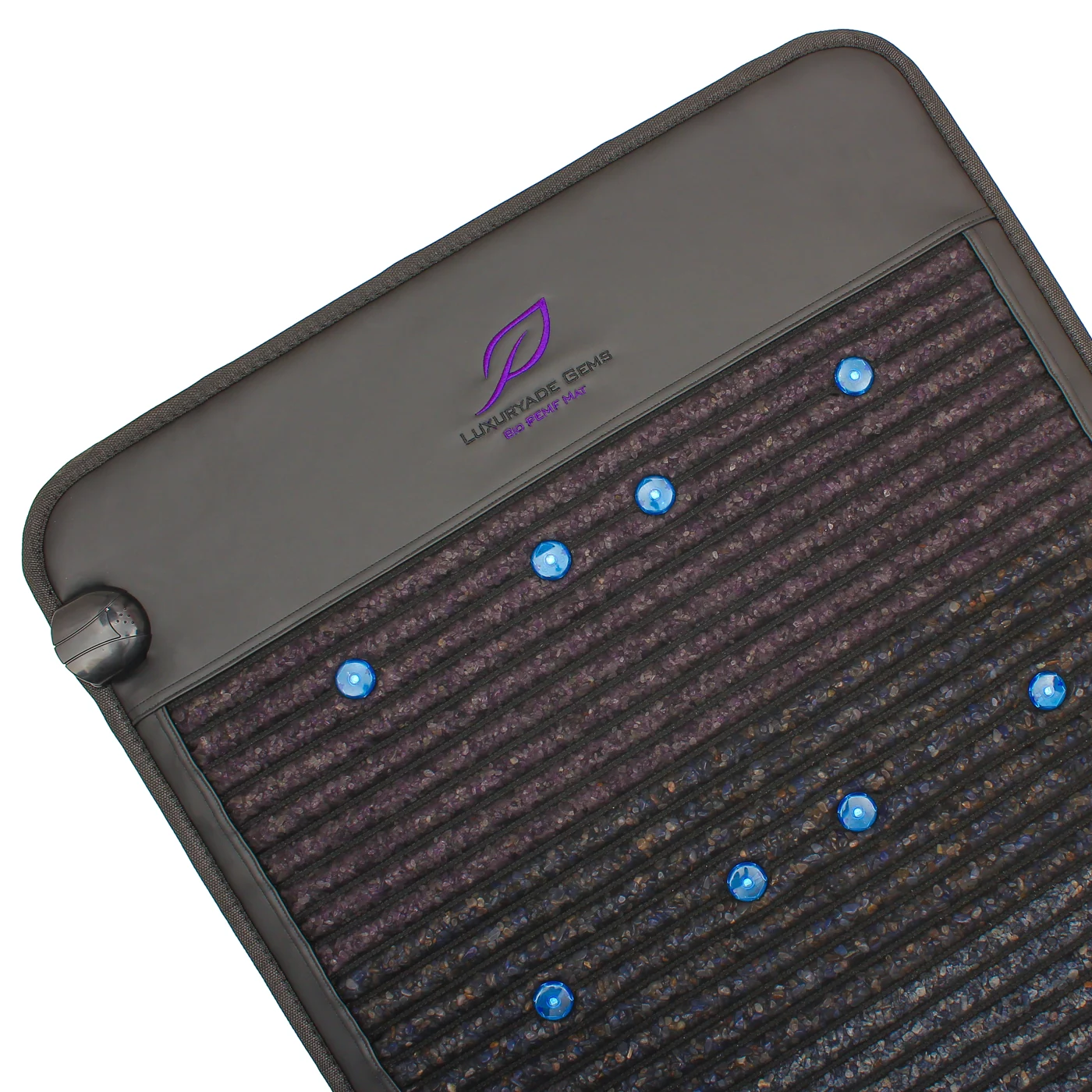
PEMF mat therapy uses pulsed magnetic fields generated by electrically driven coils inside a mat. PEMF stands for pulsed electromagnetic field. In an infrared PEMF mat, a separate heating assembly provides warmth; selected models also include red or near-infrared LEDs. We build those systems beneath a crystal or ceramic contact surface.
The three functions have separate specifications: heating is described by its controls and electrical rating; PEMF by its programs, coils and measured field; LEDs by their wavelengths, layout and optical output. A shared controller does not make those functions interchangeable.
Where the warmth comes from.
Resistive wire produces heat when powered. The layers above it warm up, including the stones and mesh. Warm objects emit infrared radiation; direct contact also transfers heat to the user. NASA’s explanation of infrared provides the physical background.
In our illustrated construction, the heating wire, temperature probe and bimetal protector have three different jobs: produce heat, report temperature and provide overtemperature protection. The heating assembly reference shows their positions.
A and LK platforms list 30–70 °C controls and a 1–12 hour timer. Those are controller capabilities. They do not mean that 70 °C is an appropriate contact temperature or that a twelve-hour contact session is recommended. Operation follows the selected model’s manual.
Heated crystals and far-infrared radiation.
The heating wire supplies energy to the mat surface. Crystals and ceramic pieces warm up and emit thermal infrared radiation. Their temperature, material and surface finish affect that emission. The stones are part of the heated assembly; they are not an independent energy source.
A contact mat transfers heat in more than one way. Radiation travels from the warm surface, while conduction transfers heat through touching materials. Mesh, clothing, a protective cover and padding influence the contact path. That is why we review the assembled sample, rather than judging warmth from a loose stone.
Far-infrared output from a heated surface is a different specification from an 850 nm LED. 850 nm equals 0.85 µm; it identifies a near-infrared light emitter. A controller temperature identifies a heating setting. The two numbers cannot replace each other.
For an OEM specification, agree the temperature-measurement position, warm-up conditions, cover and ambient temperature. A stated infrared wavelength band or emissivity needs a material or finished-product test with its method attached.
Physical background: NASA infrared reference; Vatansever & Hamblin’s FIR review.
What warmth can offer.
Heat is used for temporary comfort, muscle relaxation and stiffness relief. In its guidance for hip and knee osteoarthritis, Newcastle Hospitals describes heat as helping muscles relax, increasing local blood flow and easing stiffness for a short period.
For a mat user, temperature control, a comfortable contact surface and an appropriate resting format are the practical features behind the experience. More heat is not automatically more beneficial. The actual model’s instructions determine the cover, settings and session duration.
FIR research covers several technologies, including lamps, saunas and ceramic-containing textiles. Those have different exposure conditions from a contact mat. A study of one source should be read with its device, population and protocol before drawing conclusions about another.
Heat effects: NHS guidance. FIR technologies: 2012 FIR review.
What the coils do.
Our standard coil modules use copper wire wound around laminated silicon-steel cores. Electronic control drives them according to the selected program. The platform offers nine programs within the stated 3–64 Hz range, including preset and mixed modes.
A full-body G2613 has six coils; a compact E2610 has two. Frequency describes repetition, and coil count describes the number of modules. Field strength at the user’s position requires an instrument and defined test conditions.
The standard reference sequence is 3, 8, 10, 25, 40, 48, 56 and 64 Hz, plus a mixed mode. We confirm the controller firmware and labels for the ordered version. These are operating programs; a frequency on its own does not establish a sleep, mood or treatment outcome.
PEMF mat benefits: what does the research show?
Pain and physical function are two outcomes investigated in PEMF research. NIH / NCCIH describes potential improvements in some musculoskeletal conditions, with mixed findings between studies. When evaluating PEMF mat benefits, the relevant questions are which outcome was measured, who took part and how the device was used.
A recent trial provides a specific example:
| Study detail | Reported configuration or finding |
|---|---|
| Participants | 60 people with mild-to-moderate knee osteoarthritis; active and sham groups |
| Device & exposure | BIXEPS knee device; 1 mT, 50 Hz; 30 minutes, three times weekly for eight weeks |
| Positive result | Improved knee-extension strength at six months; improvement was not sustained at twelve months |
| Other outcomes | No between-group improvement in overall WOMAC score, cartilage thickness or joint-space width |
The study provides evidence for a defined treatment and outcome. It does not establish that any mat with a similar frequency has the same effect. Our product review identifies the model, coil arrangement, program and measured output separately.
Primary study: Lau et al., Journal of Cachexia, Sarcopenia and Muscle, 2026. The trial regimen is shown as research context, not a mat-use recommendation.
Red light and NIR are a separate function.
Our red-light platforms use 660 nm LEDs. Dual-band versions also use 850 nm near-infrared LEDs. NIR is outside visible light, so the appearance of a lit mat cannot tell you whether every NIR emitter is working.
B190 has 156 red LEDs. G2613 also has 156 LEDs, split into 96 red and 60 NIR. A063 has 154, split into 66 red and 88 NIR. Those are three different light configurations.
Photobiomodulation research considers wavelength and dose together. Hamblin’s 2017 review discusses dose-dependent responses. LED count does not establish irradiance at the skin, delivered dose or a clinical result. We do not calculate those outputs from the number of lights.
What the surface material changes.
Natural crystals and formed ceramic pieces create different textures, spacing and surface layouts. Mesh retains the surface materials; padding supports the assembly beneath them. These construction choices are reviewed on the finished sample.
Tourmaline can be natural black tourmaline within a crystal blend, or an ingredient in a formed ceramic blend. E2609 uses amethyst and natural black tourmaline; T and LK use their own ceramic compositions. Our material guide identifies the individual examples.
Four configurations from our range.
| Model | Size | PEMF | Light |
|---|---|---|---|
| G2613 | 80 × 190 cm | 6 coils · 3–64 Hz · 9 adjustable levels | 156 LEDs · 96 red / 60 NIR |
| A063 | 80 × 190 cm | 6 coils · 3–64 Hz · 9 adjustable levels | 154 LEDs · 66 red / 88 NIR |
| A7000 | 80 × 190 cm | 6 coils · 3–64 Hz · 9 adjustable levels | No photon LEDs in the standard configuration |
| LKT190 | 80 × 190 cm | Heating-only configuration | No photon LEDs |
A7000 includes heating, PEMF and TENS without photon LEDs. LKT190 is a heating-only platform. The shared mat format does not imply the same electronics.
Model data: Luxuryade June 2026 Standard Catalog, A Series and LK catalog; the linked product pages reproduce the selected configurations.
Practical benefits to assess on a finished mat.
For a wellness brand, the finished sample provides a practical way to assess warmth, placement and controls. Record those observations alongside the selected model’s specification.
Adjustable warmth: match the contact surface, controller and instructions to the desired resting format. Review warm-up behavior and temperature on the assembled sample.
Format and placement: a full-body mat provides a reclining surface. Compact pads fit behind the back or on a suitable chair, and belts fasten around the waist. Fit, support and controller access are part of the product review.
PEMF and light: define the coils, programs, LED wavelengths and controls as separate functions. A clear specification helps your team compare samples and explain the finished product accurately.
For private-label development, compare our infrared PEMF mat models and review the OEM/ODM sample process. We confirm the selected configuration in the sample and order specification. Share your intended setting, model and required changes through our product inquiry form.
Choose the format around placement.
For a home or studio resting space, measure the support surface and allow access to the controller. For seated use, check the chair, backrest, compact-pad dimensions and cable exit. A belt needs its fit and fastening reviewed around the waist.
“Bed-size” describes dimensions; it does not establish approval for overnight use. A crystal resting mat should not be assumed suitable for standing exercise. The format guide compares actual sizes and coil layouts.
Surface, heating and coil assembly.
The numbered drawing connects the crystal contact surface to the supporting, heating, insulating and magnetic assemblies. Callouts 9–10 identify the heating-wire assembly; 11 identifies the temperature probe; 12 identifies the overtemperature protector; and 16 identifies a PEMF coil module.
The heater, probe and protector perform separate jobs. The coil count and positions change with the format. Our assembly checkpoints describe how these parts are reviewed before the exterior closes the mat.
Use the instructions for the supplied model.
Placement, covers, temperature and timing follow the supplied manual. NCCIH advises checking with a healthcare provider during pregnancy or with a health condition and notes possible interference with devices such as pacemakers. A general website article cannot replace the instructions and suitability review for the actual product.
Sources & product references
These references explain heat, magnetic fields and light research. They are background sources, not clinical tests of the Luxuryade models shown here. The G2613 dimensions reflect our current factory-confirmed 80 × 190 cm specification.
Catalog basis: June 2026 Standard Catalog; A Series; PEMF LK Mat Catalog; Gems Mat Information; factory-confirmed G2613 size update: 80 × 190 cm.
- NASA Science: Infrared Waves
- Newcastle Hospitals NHS: Heat therapy and short-term comfort
- Vatansever & Hamblin, 2012: Far-infrared radiation review
- NIH / NCCIH: Magnetic therapy research
- Lau et al., 2026: Placebo-controlled PEMF trial in knee osteoarthritis
- AIMS Biophysics: Photobiomodulation mechanisms and dose response
- G2613 standard configuration
- A063 configuration
- A7000 configuration
- LKT190 configuration
- G2613 factory-confirmed 80 × 190 cm specification