
Luxuryade / PEMF specifications
PEMF Mat Frequency, Field Strength and Coil Count Explained
Read Hz, gauss, microtesla and coil quantities correctly, then compare the complete PEMF configuration.
In this guide
Frequency: what Hz tells you.
Hertz means cycles per second. NIST’s SI reference defines Hz as s⁻¹. In a PEMF specification, the supplier should identify what repeats: the magnetic waveform, a pulse or a burst envelope.
Our standard platform lists nine selectable programs within 3–64 Hz. A stated range does not mean every value can be selected continuously. Fixed programs and a mixed mode need their own controller description.
Frequency alone does not state waveform, pulse width, duty cycle or magnetic-field amplitude. Two products carrying the same Hz label can have different outputs.
Field strength: read the unit and test conditions.
Tesla (T), microtesla (µT) and gauss (G) are units of magnetic flux density. NIST SP 811, Appendix B gives 1 G = 10⁻⁴ T. Therefore 1 G = 100 µT = 0.1 mT.
For example, 50 µT equals 0.5 G. That conversion changes the unit, not the output. It also says nothing about the mat’s effectiveness.
A useful measurement states the mode, position, distance and amplitude convention, such as peak or RMS. A value measured against an uncovered coil is not directly comparable with a value measured above a finished mat. Waveform must be known before converting between peak and RMS.
Coil count: a construction detail, not an output measurement.
| Model | Size | PEMF |
|---|---|---|
| E2610 | 38 × 70 cm | 2 coils · 3–64 Hz |
| G2613 | 73.5 × 185 cm | 6 coils · 3–64 Hz |
| A063 | 80 × 190 cm | 6 coils · 3–64 Hz |
| T1500 | 150 × 200 cm | 12 coils · 3–64 Hz |
The wider T1500 uses twelve coils, while the compact E2610 uses two. Size, module positions and the surrounding construction differ. Twelve coils do not establish twice the field strength, and six coils do not establish uniform field coverage.
Model data: June 2026 Standard Catalog, A Series and T-series catalog. Each linked model has its own configuration.
Waveform, program and layout belong together.
A complete PEMF description connects the electronic drive to the coil system. It identifies the waveform, frequency or program, coil layout and measured magnetic output. If a program changes over time, the test record needs to show which point in that program was measured.
Our construction example uses copper wire wound around laminated silicon-steel cores. Coil position, fixing and cable routing form part of the assembly drawing. The coil construction reference explains that hardware; the diagram is an illustration, not a field map.
An indicator shows activity; an instrument measures the field.
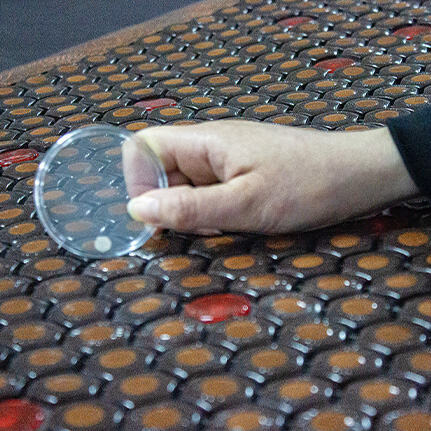
The small magnetic indicator shown in our factory photograph responds visibly to coil operation. It is useful for a basic operating demonstration. Its movement does not give a calibrated gauss or µT value.
For a quantitative review, define the following before requesting a report:
| Item | Record |
|---|---|
| Product version | Model, controller, electrical version and completed surface construction |
| Operating condition | Selected program, waveform and point in the program |
| Probe position | Distance above the contact surface and position relative to the coils |
| Instrument | Meter, probe orientation, calibration and relevant frequency response |
| Result | Unit, peak or RMS convention, and values at the stated positions |
This is our technical procurement checklist. It does not claim that the indicator photograph contains those measurements or that a test report is available for every custom configuration.
Sources & product references
The external references explain physical terms and units. Model data is from our catalog specifications; measurement-review questions are Luxuryade factory guidance.
Luxuryade catalog basis: June 2026 Standard Catalog; A Series; Tourmaline T Series; Gems Mat Information.